
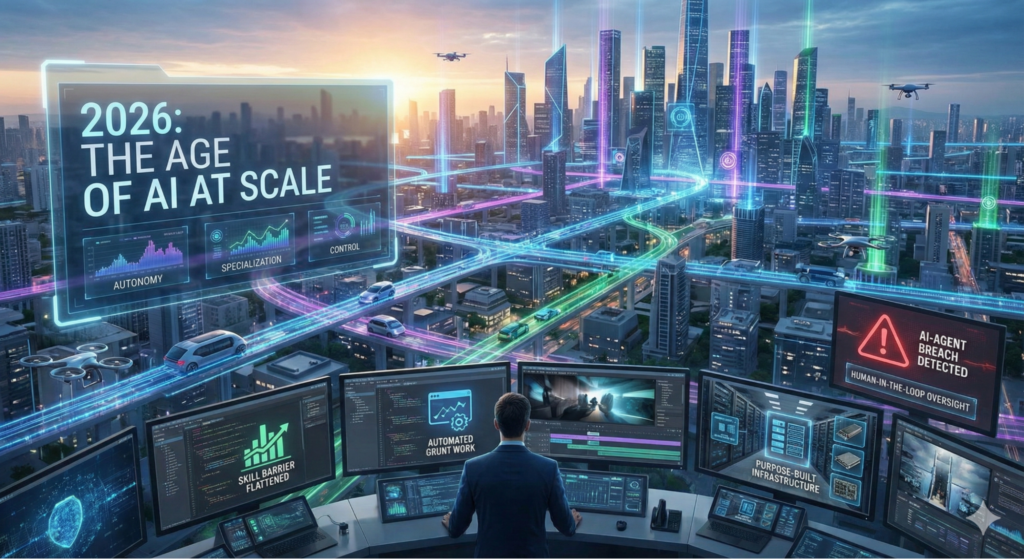

Scale is the theme that takes technology to 2026. AI systems are doing more, making more decisions and operating with less direct supervision as they spread across industries.
As 2026 approaches, executives and leaders in security, infrastructure and artificial intelligence are beginning to agree on what will change at this scale. Their forecasts, shared in exclusive interviews with TechRepublic, outline a year defined by autonomy, specialization and the need for tighter control.
1. Artificial intelligence is leveling technical skill barriers
As artificial intelligence takes over more repetitive technical work inside organizations, the advantage that deep specialists once had will continue to narrow. Tasks that require years of training, including large parts of software development, will increasingly be handled by systems that assist or automate execution.
Matthias Steiner, senior director of Global Business Innovation at Syntax, said he expects this change to accelerate in 2026. As AI “levels the coding field,” he notes that competitive advantage will no longer depend solely on coding skills, but on teams that can handle the entire software lifecycle, from strategy and domain-driven decisions to execution and ongoing oversight.
2. The most reliable AI wins won’t be flashy
AI’s biggest gains in 2026 are expected to come from work that rarely gets attention. Value is consolidated around tasks that consume time, cost and human effort.
Hanno Basse, CTO of Stability AI, said the strongest near-term returns will come from automating “necessary but repetitive grunt work.” He points to content production tasks such as wire stripping in visual effects—a painstaking post-production process traditionally done pixel by pixel—as examples where generative AI can dramatically speed up output without changing creative intent or decision-making.
3. The era of universal technologies is ending
The idea that a single, one-size-fits-all system can meet most business needs is losing credibility. As AI and data-driven workloads move into core operations, it’s getting harder to ignore the limits of generic platforms.
Udo Sglavo, vice president of applied artificial intelligence and modeling (R&D) at SAS, predicts that the belief that “one big universal language model will replace most enterprise software” will not hold up. Organizations, he notes, rely on tightly controlled systems that must be reliable, explainable and compliant, so it’s unrealistic to entrust critical operations to a single, opaque model. Instead, it expects smaller, specialized AI components governed by clear business rules and continuously monitored in production.
The same push for accuracy is reshaping the infrastructure beneath these systems.
Barry Baker, chief operating officer and CEO of IBM Infrastructure, says “the era of generic AI infrastructure will end in 2026” as companies abandon identical servers as a one-size-fits-all solution. He said hardware and software designed together for specific workloads will be critical to meeting real-world requirements for latency, cost, reliability and energy efficiency.
The shift also reaches the user layer. Shawn Yen, vice president of product planning at ASUS, expects AI to move from general chat-based interfaces to tools designed for specific users and workflows. Rather than universal assistants, they see AI embedded directly into how SMBs manage productivity and how creators invent, generate and organize content; purpose-built systems optimized for what people are really trying to do.
4. Autonomy replaces lock-in
After years of price gouging and inflexible terms, more teams will move to cloud environments that give them the flexibility to choose, adapt and move without being pigeonholed.
James Lucas, CEO of CirrusHQ, predicts that autonomy will become a defining priority as organizations move to cloud marketplaces and modular services that offer greater freedom. But with that freedom comes risk. Without automated oversight, Lucas warns, shadow IT can undermine compliance and data sovereignty, making cloud environments harder to manage as they become more independent.
5. Autonomous AI agents create a new attack surface
As organizations deploy AI agents that operate more autonomously, security teams face risks unlike traditional threats. Unlike scripted automation, these agents can interact with systems, data, and third parties with minimal human oversight, often faster than existing controls can follow.
Jessica Hetrick, vice president of Federal Services at Optiv + ClearShark, warns that autonomous AI agents will enable more sophisticated attacks that are harder to trace and attribute. Because agents can act on behalf of users and systems, he says, they expand the scope for attacks in ways that older security models were never designed to monitor.
6. Observability becomes non-negotiable
Experts expect observability to become a fundamental requirement for operating complex technology at scale, especially when systems make decisions and execute actions with limited human input.
Maryam Ashoori, vice president of product and engineering at watsonx.gov, says businesses will run dozens or even hundreds of AI agents in parallel, often built by different teams and running on multiple platforms.
At this scale, he adds, organizations will be forced to prioritize observability, evaluation and policy enforcement to understand how agent systems behave in real-world conditions and keep autonomous workflows under control.
7. The first AI-agent breakthrough is reshaping cybernetic training
The next big change in cybersecurity will be caused by failures that force organizations to rethink how people work with autonomous systems.
Tiffany Shogren, director of cyber security services and education at Optiv, predicts that a major incident driven by AI agents will redefine cyber training standards. He says organizations will be forced to implement formal “AI oversight” and human-in-the-loop modules that instruct employees to understand when and how to challenge, intervene and suppress automated behavior, not just passively observe it.
What scale ultimately requires
By 2026, technology will no longer have the benefit of the doubt. Systems will be evaluated in production, under load, across teams, regulators and budgets, with little patience for fixes that arrive later. What survives will be what was designed to work continuously, not just make an early impact.
The predictions here describe a narrowing field. As technology advances, tolerance decreases and expectations are set.
Next year belongs to platforms, workflows, and controls that were built with scale in mind from the ground up—because with the advent of time scale, there’s rarely room for the discipline of retrofitting.
Learn how one cybersecurity insider expects AI-driven threats, predictive SOC, and trust and identity breaches to put pressure on security teams in 2026.