

|
Managing database environments requires a balance between resource efficiency and scalability. Organizations need flexible capabilities across the entire database lifecycle, including development, test, and production workloads with varying storage and compute requirements.
To meet these needs, we are announcing four new features for Amazon Relational Database Service (Amazon RDS) that will help customers optimize their costs as well as improve the efficiency and scalability of their Amazon RDS for Oracle and Amazon RDS for SQL Server databases. These enhancements include SQL Server Developer Edition support and enhanced storage options for RDS for Oracle and RDS for SQL Server. Additionally, you can have CPU optimization options for RDS for SQL Server on M7i and R7i instances, which offer price reductions over previous generation instances and separately billed license fees.
Let’s explore what’s new.
SQL Server Developer Edition support
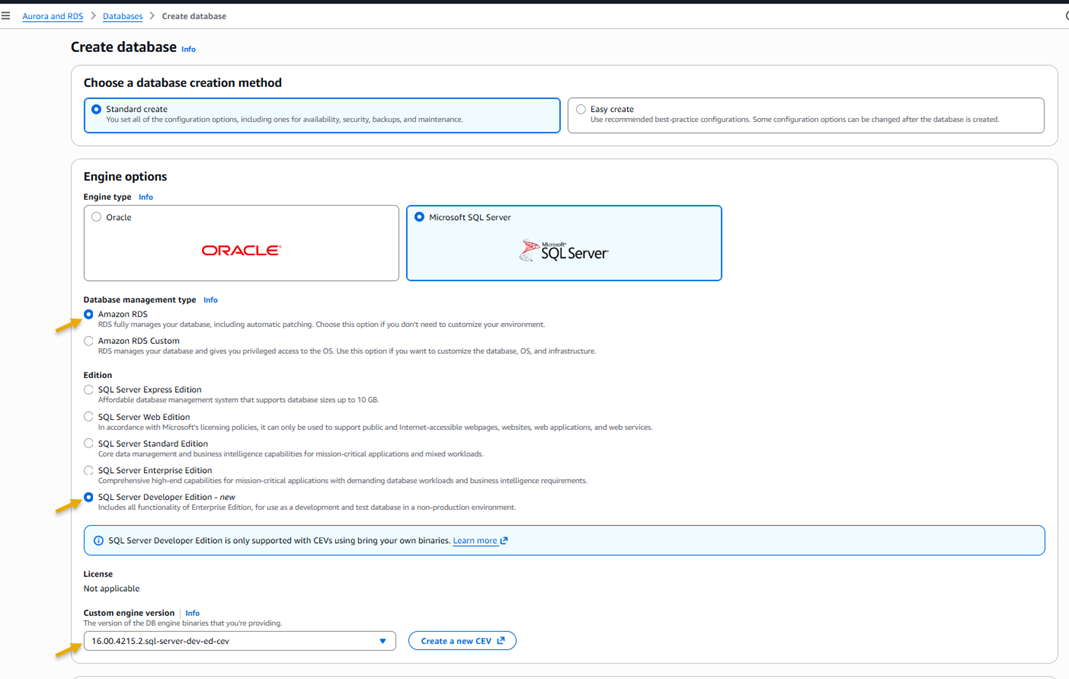
SQL Server Developer Edition is now available on RDS for SQL Server and offers a free version of SQL Server that includes all the features of the Enterprise Edition. The Developer Edition is licensed specifically for non-production workloads, so you can build and test applications without incurring the cost of SQL Server licenses in development and test environments.
This release brings significant cost savings to your development and test environments while maintaining consistency with your production configurations. You’ll have access to all Enterprise Edition features in your development environment, making it easier to test and validate your applications. In addition, you’ll benefit from the full feature set of Amazon RDS, including automatic backups, software updates, monitoring, and encryption capabilities throughout your development process.
To get started, upload your SQL Server binaries to Amazon Simple Storage Service (Amazon S3) and use them to create a Developer Edition instance. You can migrate existing data from Enterprise or Standard Edition instances to Developer Edition instances using SQL Server’s built-in backup and restore operations.
M7i/R7i instances on RDS for SQL Server with CPU optimization support
You can now use M7i and R7i instances on Amazon RDS for SQL Server to achieve several key benefits. These instances offer significant cost savings over the previous generation of instances. You also get better database cost transparency with license fees and Amazon RDS DB instance costs billed separately.
RDS for SQL Server M7i/R7i instances offer up to 55% lower costs compared to previous generation instances. 

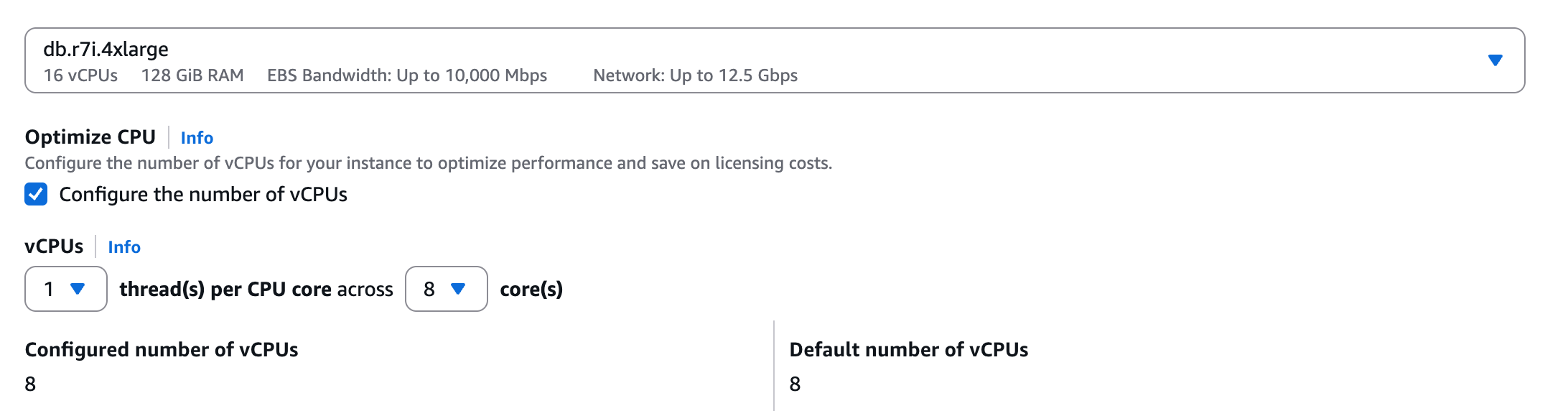
By optimizing CPU capacity in these instances, you can adjust the number of vCPUs on RDS licensed for SQL Server instances. This improvement is particularly valuable for database workloads that require large memory and input/output operations per second (IOPS) but lower vCPU counts
This feature provides substantial benefits to your database operations. You can significantly reduce vCPU-based licensing costs while maintaining the same level of memory and IOPS performance that your applications require. This feature supports a higher memory to vCPU ratio and automatically disables hyperthreading while maintaining instance performance. Most importantly, you can fine-tune your processor settings to precisely match your specific workload requirements and provide optimal resource utilization.
To get started, select an instance type of M7i or R7i when creating a new SQL Server database instance. Below Optimize CPU choose Configure the number of vCPUs and set the desired number of vCPUs.
Additional storage volumes for RDS for Oracle and SQL Server
Amazon RDS for Oracle and Amazon RDS for SQL Server now support storage sizes up to 256 TiB, which is a fourfold increase in storage size per database instance by adding up to three additional storage volumes.
Additional storage volumes provide extensive flexibility in managing your database storage needs. You can configure your volumes with both io2 and gp3 volumes to create an optimal storage strategy. You can store frequently used data on high-performance Provisioned IOPS SSD (io2) volumes while keeping historical data on cost-effective General Purpose SSD (gp3) volumes, balancing performance and cost. For temporary storage needs, such as month-end processing or data import, you can add storage volumes as needed. After these operations are complete, you can empty the volumes and then remove them to reduce unnecessary storage costs.
These storage volumes offer operational flexibility with zero downtime, and you can add or remove additional storage volumes without interrupting database operations. You can also scale multiple volumes in parallel to quickly meet growing storage requirements. In the case of a Multi-AZ deployment, all additional storage volumes are automatically replicated to maintain high availability.
You can add storage volumes to new or existing database instances through the AWS Management Console, the AWS Command Line Interface (AWS CLI), or the AWS SDKs.
Let me show you a quick example. I will add a storage volume to an existing RDS database instance for Oracle.
First I go to the RDS console and then to the RDS for Oracle database instance details page. I’ll look in the Configuration and find Additional storage volumes section.
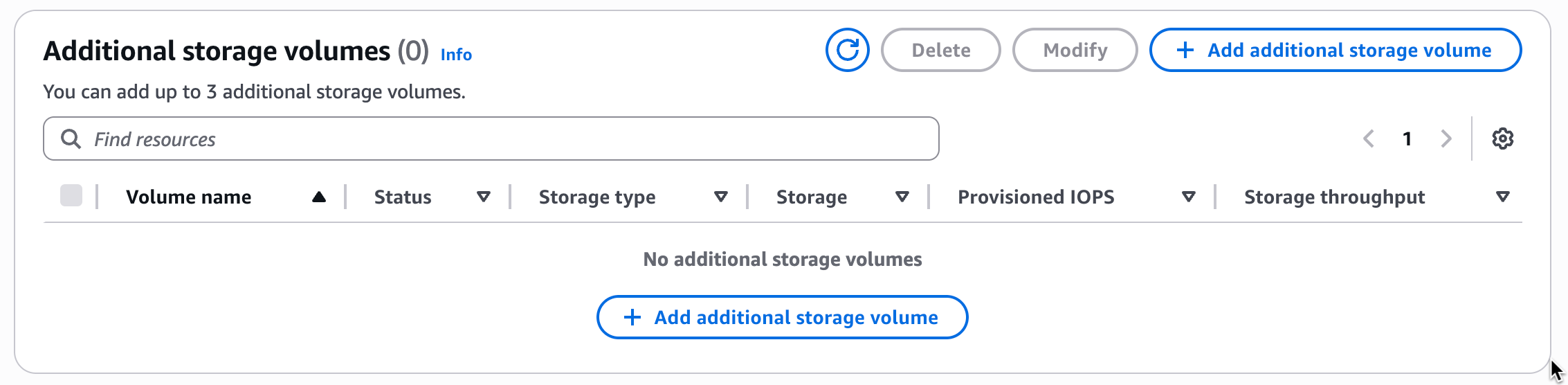
You can add up to three additional storage volumes, and each must be named according to the naming convention. The storage volumes cannot have the same name and you must choose between rdsdbdata2, rdsdbdata3 and rdsdbdata4. For RDS DB instances for Oracle, I can add additional storage volumes with a primary storage size of 200 GiB or greater to the DB instance.
I’m going to add two parts, so I’m choosing Add more storage and then fill in all the required information. i choose rdsdbdata2 as the volume name and assign it 12,000 GiB of allocated storage with 60,000 provisioned IOPS on the io2 storage type. For my second extra storage rdsdbdata3i decided to have 2000 GiB on gp3 with 15000 secured IOPS.
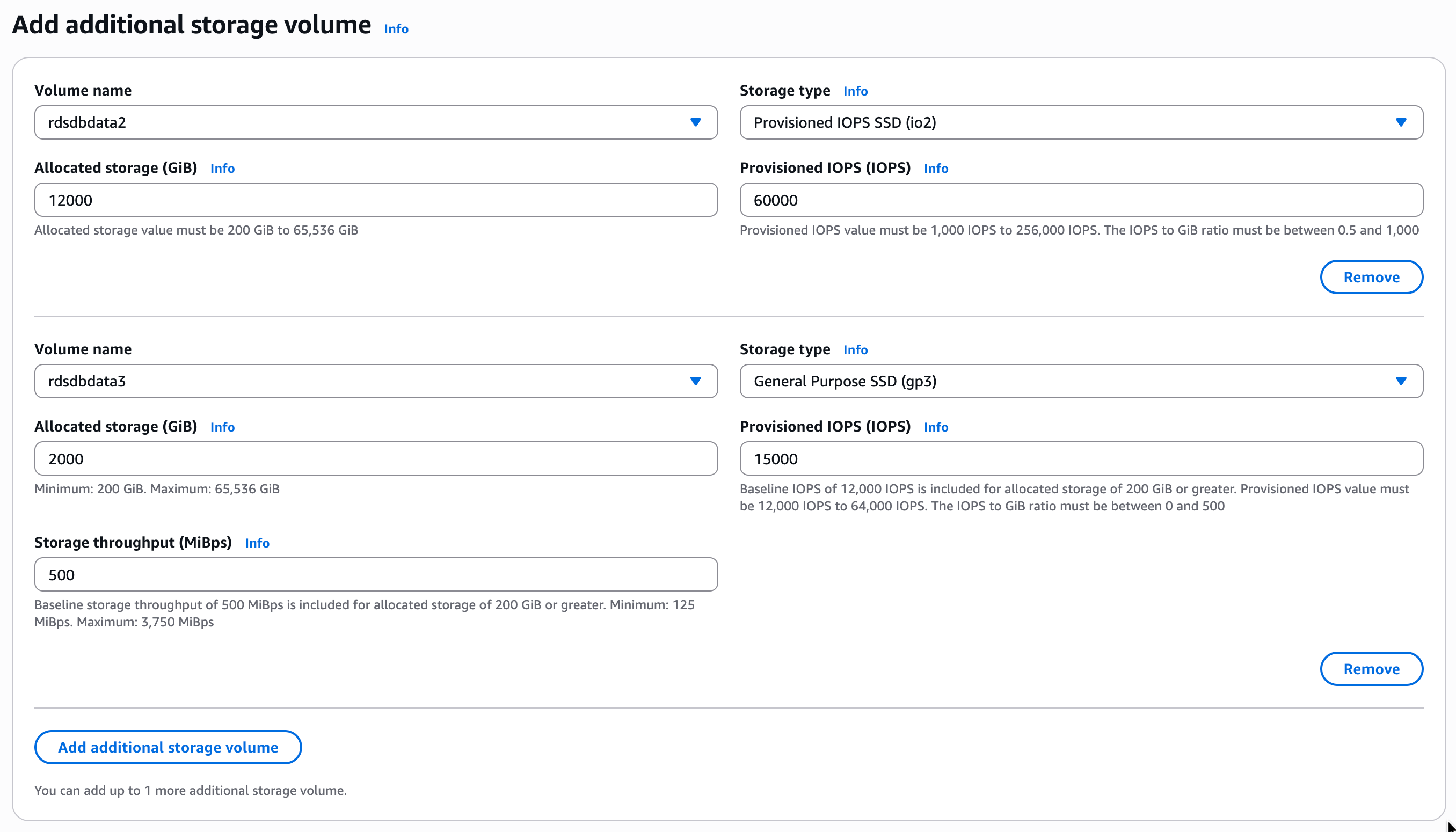
After confirmation, I wait for Amazon RDS to process my request and then my other volumes are available.
You can also use the AWS CLI to add volumes while creating or modifying database instances.
Things you should know
These features are now available in all AWS commercial regions and AWS GovCloud (US) regions where Amazon RDS for Oracle and Amazon RDS for SQL Server are offered.
You can learn more about each of these features in the documentation for Amazon RDS for Developer Edition, CPU Optimization, Additional Storage Volumes for RDS for Oracle, and Additional Storage Volumes for RDS for SQL Server.
To learn more about the released pricing structure for M7i and R7i instances on RDS for SQL Server, visit the Amazon RDS for SQL Server pricing page.
To get started with any of these features, go to the Amazon RDS console or learn more in the Amazon RDS documentation.